
Most people picture a construction site as a place where vision is required, from reading tape measures to spotting hazards and lining up cuts. Yet Mike DeZinno, known as Americas Blind Tradesman, has built a life in the skilled trades while blind. His story, featured in a WIS News 10 interview, shows what happens when a person refuses to accept the limits other people assign.
At the center of this profile is a simple idea: your life’s value doesn’t come from the few tasks you can’t do. It comes from the many you can. DeZinno’s work, from home repairs to large builds, puts that belief into practice.
https://www.youtube.com/watch?v=_r8aoxl8kX8
Defying the odds on the construction site
Construction work often gets described as hands-on, but it is also sight-heavy. Plans, levels, alignment, safety markings, and constant motion all assume that a worker can see and react in real time. That assumption is exactly why Mike DeZinno stands out.
Before his Habitat for Humanity build in Eastover, the WIS News 10 segment frames him as the “blind tradesman,” a man who “fixes and builds just about everything while being blind.” The point is not novelty. The point is competence, shown in spaces where many people would think competence is impossible.
Why building blind seems impossible
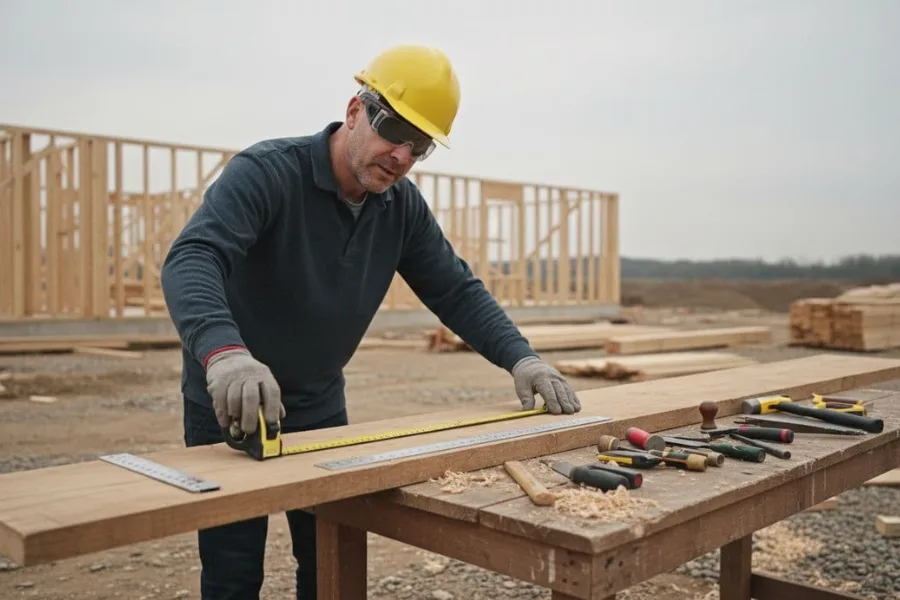
Imagine the difficulty of building a house. Now turn off the lights and finish it. Impossible, right? Construction demands accuracy, repetition, and safe movement around sharp tools and heavy materials. For many viewers, that mental picture sets the baseline for understanding what DeZinno does.
The interview does not claim the work is easy. Instead, it shows how DeZinno treats the work as something to solve, one method at a time.
Mike’s mindset shift
DeZinno explains his turning point in plain language: “I just got tired of being told no, you can’t, you shouldn’t, there’s no way. And I just began to find ways to do the job…” That line matters because it describes a shift from arguing about barriers to testing practical alternatives.
The segment also captures his core theme: No limits. In context, “no limits” is not a slogan about ignoring risk. It is a decision to stay focused on what can be built, repaired, learned, and finished, even if the process looks different than it does for someone who sees.
Mike’s early start as the man of the house
Many tradespeople can point to a first job or a first mentor. DeZinno’s origin story begins earlier and closer to home. He has been blind and building since childhood, and his work started from need rather than choice.
The interview states that his father left home, and Mike became the man of the house. That change did not simply add responsibility. It forced action. When no one else could fix what broke, he learned to fix it.
Stepping up after dad left
DeZinno describes the moment with direct cause and effect: “Well then that meant I had to take care of things, so I started fixing things.” The statement carries a practical logic that many families recognize. Things still break even when life becomes unstable. Meals still need to be cooked. Heat still has to work. Daily living still demands working systems.
Because of that, his skill development did not happen in a classroom first. It happened at home, under pressure, with immediate consequences if a repair failed.
Growing skills at home
Early repairs started small, then moved into larger systems. DeZinno recalls progressing to work on household equipment, including the dishwasher and the furnace. Those are not decorative projects. They are functional systems tied to sanitation, comfort, and safety.
A few examples mentioned in the interview include:
- Small repairs around the house: the kind of work that teaches problem-solving and tool familiarity
- Dishwasher fixes: troubleshooting a working appliance with moving parts and water lines
- Furnace work: addressing a home’s heating system, where correct diagnosis matters
This early period matters because it frames his later career as continuity. The trades were not a side interest. They were how he kept life running.
Mastering 13 trades without sight
The WIS News 10 segment reports that DeZinno knows 13 trades, and it presents that breadth as both learned skill and lived habit. He did not stop at household repairs. He went on to train, work, and earn credentials.
While the interview does not list all 13 trades, it gives clear examples of the range: construction, mechanical work, and specialized engineering.
Learning construction and more
DeZinno learned construction as an apprentice, which implies structured learning under experienced guidance. At the same time, his life pushed him into other work. The interview highlights a vivid example from his time as a guitar player in a band that could not afford a nice bus. Limited resources meant he had to keep vehicles moving, even in poor conditions.
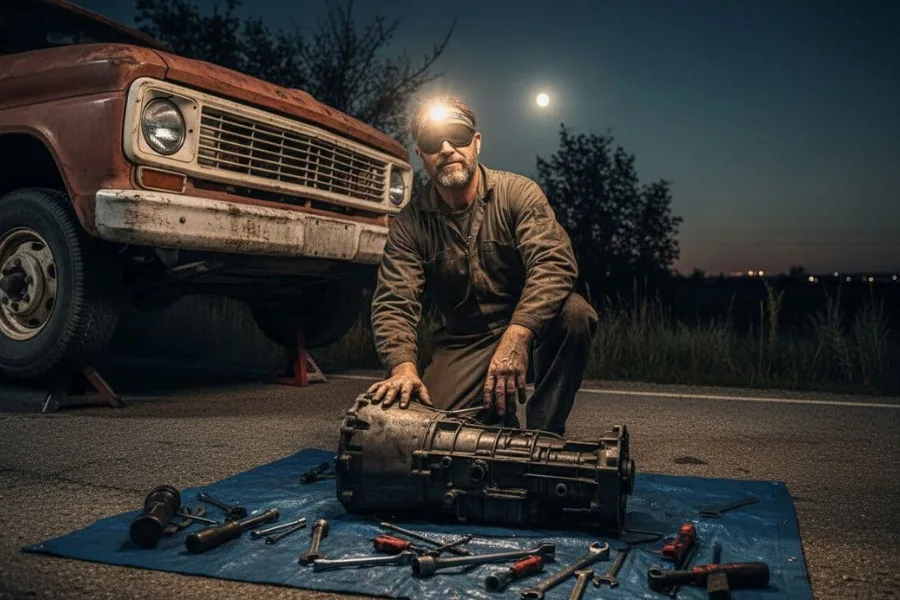
He explains the experience with a line that sticks: “That’s when I learned how to be an auto mechanic in a ditch. I used to drop the transmissions, put clutches in, everything else, because I could work on the side of the road at two in the morning. I didn’t need light.”
That quote does two things at once. First, it shows the physical reality of his work, including rough locations and late hours. Second, it reframes blindness as a condition that does not remove his ability to work by feel, sequence, and memory.
His impressive expertise
The segment states that DeZinno knows 13 trades and is certified in geothermal engineering and design. That combination is important because it bridges hands-on work and technical systems thinking. “Engineering and design” suggests he understands planning and performance, not only installation and repair.
Based on what the interview explicitly mentions, his experience includes:
- Construction (learned through apprenticeship)
- Auto mechanics (including transmissions and clutches, done on the roadside when needed)
- Home repairs (including the dishwasher and furnace work that began in childhood)
- Geothermal engineering and design (formal certification noted in the report)
The larger takeaway is not the number alone. The takeaway is sustained learning over time. He adds skills when life requires them, then keeps those skills sharp through use.
For readers who want to follow his work and initiatives more closely, the official site, America’s Blind Tradesman and Mike DeZinno’s ongoing projects, provides updates and ways to join “the crew.”
Tackling big projects like a pro
Skill matters most when conditions get complicated. A construction site is not a quiet workshop. It is noisy, time-sensitive, and full of moving parts. The interview addresses the question many viewers likely ask: how does a blind tradesman work safely and effectively in that setting?
DeZinno’s answer centers on preparation and mental rehearsal. He does not describe a single trick. He describes a method.
Preparing for the job site without sight
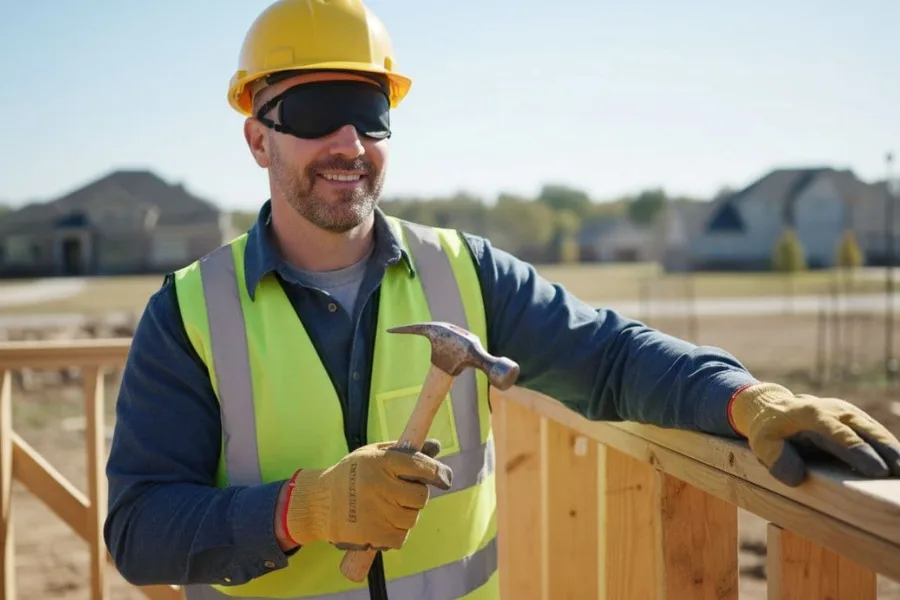
DeZinno explains that his work starts before he arrives: “Long before I get to the job site, I rebuilt this thing three times in my mind just dreaming about it.” In other words, he relies on deep pre-visualization, planning, and repetition. The statement also hints at something tradespeople understand well: a clean build depends on thinking ahead, not only reacting in the moment.
He also treats mistakes as manageable. The “worst thing” is not catastrophe, it is normal job-site friction: “The worst thing that could happen is I cut it too short or cutting too long and have to cut it again. Or I bend the nail, you know? Or I hit my thumb.”
That framing matters because it places him in the same world as other builders. Measurements get re-done. Nails bend. Thumbs get hit. What changes is the strategy used to avoid the errors that matter most.
A short line from the segment captures his risk-aware humor about the work:
“It’s a good day if you can end with ten, you know?”
He says it while confirming he still has all 10 fingers. The joke lands because it also signals seriousness. He respects tools, he expects hazards, and he measures success in safe outcomes as well as finished tasks.
Helping Habitat for Humanity in Eastover and the Midlands
The story’s immediate news hook is a build event: the report says that “tomorrow in Eastover,” Habitat for Humanity will get help from DeZinno as he works construction while blind. The broader context places this work “right here in the Midlands,” connecting the project to local community building.
DeZinno also shares a long-term goal: “Yeah I have been wanting to work on a habitat project for over 20 years…” That line adds time and patience to the story. Habitat builds are not only construction tasks. They are civic projects with volunteer coordination, shared standards, and tight schedules. Wanting to join that work for two decades signals commitment to service, not only trade skill.
The segment also notes that he is working on a reality TV show with Habitat for Humanity. While details are not provided in the interview, the mention suggests that his method of working, and the projects themselves, will reach a wider audience.
For updates, background, and related programs that promote skilled trades and self-employment, America’s Blind Tradesman and Mike DeZinno’s official site serves as the central hub.
Mike’s message: focus on what you can do
The WIS News 10 piece opens with a principle that shapes the entire profile: “The value your life is not going to be determined by the few things you can’t do but by the many things you can do.” That claim works as an ethical statement, but it also works as a practical guide. It pushes attention away from deficit and toward action.
Inspiring others to reach full potential
DeZinno hopes his story encourages people to look beyond circumstances and “be all they can be,” realizing full potential. The segment closes with the phrase “That’s right, no limits,” which echoes his earlier refusal to accept imposed boundaries.
In this sense, the identity “Americas Blind Tradesman” functions as more than a nickname. It marks a public example of skilled work under conditions many people assume cannot support it. It also reframes disability through capability and method, rather than through pity or surprise.
Thanks, Taylor.
Conclusion
Mike DeZinno’s story is not built on inspirational language alone. It rests on visible work, learned skill, and the steady choice to keep building. From early home repairs, to roadside mechanical work, to Habitat for Humanity projects in the Midlands, he shows that competence grows through practice and preparation. If one theme holds the entire profile together, it is no limits, understood as disciplined problem-solving rather than wishful thinking. What could change if more people judged their future by what they can do, and then got to work?
Recent Comments